

What is Electrical Muscle Stimulation?
Electric muscle stimulation uses electrical impulses to cause muscles to contract, resulting in stronger, more toned muscles. Your brain sends an electric signal to your muscles, and they contract in response. Nuzuna Technology replicates this process, but at a higher intensity. Our EMS device sends electronic pulses to your motor nerves, causing many more muscles fibers to contract than possible during your regular workout.
We’ve taken the proven concept of neuromuscular electric stimulation (NES, or NMES) and created a lightweight, portable smart EMS device that you can use to strengthen, build and relax muscles–all in one. Neuromuscular electric stimulation is a procedure where small electric impulses are used to stimulate, or excite muscles that are weak or paralyzed. Neuromuscular electric stimulation is a type of medical treatment and physical therapy that helps increase blood circulation in targeted muscles, strengthen and re-train those muscles, lessen muscle spasms, and increase a patient’s range of motion.

What are the Benefits of Electric Muscle Stimulation?
Many of the world’s top athletes still use electrical muscle stimulation to enhance their training. But now more than ever, electric muscle stimulation is available to a wider, more mainstream audience. Using an EMS device like Nuzuna technology products can accelerate your fitness performance, build muscle strength and strength endurance, and recover faster and more fully without a trip to the doctor, physical therapist, or even the gym. Electrical muscle stimulation of this type can be used easily and discreetly on-the-go or in the comfort of your own home. Our EMS device is clinically proven, FDA cleared and safe for weekly use.
Electrical muscle stimulation helps:
- Improve muscle performance
- Strengthen muscles
- Increase muscle growth
- Increase local blood circulation
- Relax muscles
- Reduce muscle soreness
- Prevent muscle atrophy
- Tone muscles
- Improve bone density
- Reduce incontinence problems
- Reduce cellulite
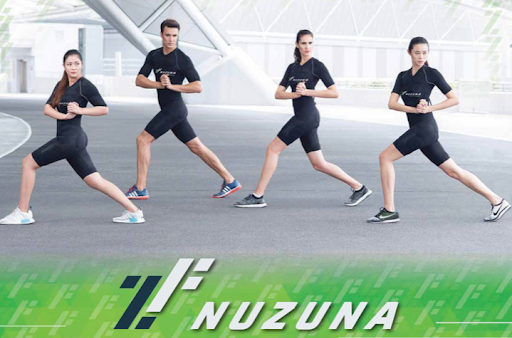
Electrical muscle stimulation is meant to be paired with your training routines and workout programs to enhance fitness performance, and support muscle recovery in between workouts or post workout. When correctly and consistently integrated into your workout routine, electric muscle stimulation helps support your fitness journey at all stages and at any fitness level.
With our 9-32 preset programs (quantity depends on our App version-home/pro/poAthlet/rehab) and customizable settings, you can access highly effective electric muscle stimulation designed to help you run faster, jump higher and go longer than you’ve ever experienced in your traditional workout.
There is an increasingly popular fitness trend sweeping the nation and quickly being adopted across the globe: electrical muscle stimulation for workouts or fitness recovery. Interestingly, EMS technology has been around for decades. Many doctors and physical therapists have used electric muscle stimulation treatments to help top athletes or patients in recovery. But up until now, EMS equipment has been bulky, expensive, and difficult to harness the power of electrical muscle stimulation at home.
Now that EMS workouts are gaining in popularity, the fitness industry is gearing up to fill the demand for portable EMS devices. What’s exciting is that Nuzuna Technology products is the only lightweight, portable EMS device designed for regular use at home or at the gym and also a special edition for rehab. Nuzuna Technology is all science and technology. Our electric muscle stimulator is completely wireless and pairs with our elegant mobile app for pre-set fitness, training and rehab programs in the palm of your hand. Nuzuna Technology is FDA cleared, clinically proven and backed by scientific research.
These studies highlight the growing body of research supporting the use of EMS in rehabilitation, showing its effectiveness across various conditions from orthopedic to neurological recovery.
Neuromuscular Electrical Stimulation in Early Rehabilitation After ACL Reconstruction: A Randomized Controlled Trial
Main Focus
Finding enhanced muscle recovery and improved function compared to standard care.
Authors
Fisher MI, Lempke LB, et al.
Published
Physical Therapy, 2018
Summary
This trial investigated EMS for quadriceps strength and functional recovery after ACL reconstruction.
Efficacy of Neuromuscular Electrical Stimulation in Achilles Tendon Repair Rehabilitation: A Randomized Controlled Study
Authors
Elbaz A, Beer Y, et al.
Published
Foot & Ankle International, 2019
Summary
This study investigated EMS in the rehabilitation of patients after Achilles tendon repair.
Effects of Neuromuscular Electrical Stimulation on Quadriceps Strength and Function in Total Knee Arthroplasty Patients: A Randomized Controlled Trial
Main Focus
Showing significant improvements in muscle strength and mobility.
Authors
Petterson SC, Mizner RL, et al.
Published
Physical Therapy, 2020
Summary
This study assessed the benefits of EMS in post-surgery rehabilitation for total knee arthroplasty patients.
Role of Electrical Stimulation Therapy in the Recovery of Muscle Strength in Patients With Knee Osteoarthritis: A Randomized Controlled Trial
Authors
Lima TB, Neto LV, et al.
Published
Journal of Physical Therapy Science, 2016
Summary
The trial assessed the impact of EMS on quadriceps strength and overall function in patients with knee osteoarthritis.
Neuromuscular Electrical Stimulation in Rehabilitation of Patients With Osteoarthritis: A Systematic Review
Authors
Stevens-Lapsley JE, Schenkman M, et al.
Published
Journal of Aging and Physical Activity, 2015
Summary
This review focused on the use of EMS in patients with osteoarthritis.
The Use of Neuromuscular Electrical Stimulation in Rehabilitation of Patients With Spinal Cord Injury: A Systematic Review
Authors
Gorgey AS, Dudley GA.
Published
Spinal Cord Medicine, 2017
Summary
A systematic review evaluating the efficacy of EMS in improving muscle strength and function in patients with spinal cord injuries.
Effect of Neuromuscular Electrical Stimulation on Muscle Strength in Patients With COPD: A Systematic Review and Meta-Analysis
Main Focus
Highlighting improvements in muscle strength and endurance.
Authors
Vargas F, Lobato R, et al.
Published
Respiratory Care, 2021
Summary
This meta-analysis focused on the impact of EMS in chronic obstructive pulmonary disease (COPD) rehabilitation.
Neuromuscular Electrical Stimulation in Rehabilitation of Stroke Patients: A Meta-Analysis
Main Focus
The study showed significant improvements in muscle strength and spasticity reduction.
Authors
Xie Q, Zhang X, et al.
Published
Clinical Rehabilitation, 2020
Summary
A comprehensive review of EMS use for motor function recovery in stroke patients.
Neuromuscular Electrical Stimulation for Patients with Shoulder Dysfunction After Stroke: A Randomized Controlled Trial
Authors
Meng P, Zhang S, et al.
Published
Clinical Rehabilitation, 2018
Summary
This study examined the effects of EMS in post-stroke patients with shoulder dysfunction.
Effects of Electrical Stimulation on Motor Recovery in Early Stroke Rehabilitation: A Randomized Controlled Trial
Main Focus
Demonstrating improved arm and hand function in patients receiving EMS treatment.
Authors
Chae J, Fang Z, et al.
Published
Stroke, 2018
Summary
This trial studied the effect of EMS on motor recovery in early stroke rehabilitation.
Neuromuscular Electrical Stimulation and Gait in Parkinson’s Disease: A Randomized Controlled Trial
Main Focus
Showing enhanced walking ability and balance when compared to non-EMS interventions.
Authors
Picelli A, Tamburin S, et al.
Published
Neurorehabilitation and Neural Repair, 2015
Summary
This trial evaluated the effect of EMS on gait improvement in Parkinson’s disease patients.
The Use of Electrical Stimulation for Muscle Atrophy Prevention in Heart Failure Patients: A Systematic Review
Main Focus
Showing positive outcomes in muscle mass preservation and improved exercise tolerance.
Authors
Sbruzzi G, Ribeiro RA, et al.
Published
European Journal of Cardiovascular Prevention & Rehabilitation, 2015
Summary
This review focused on the use of EMS in heart failure patients to prevent muscle atrophy.
Use of Functional Electrical Stimulation-Assisted Gait Training in Patients With Multiple Sclerosis: A Randomized Controlled Study
Authors
Duffell LD, Gulati V, et al.
Published
Multiple Sclerosis Journal, 2019
Summary
The trial examined the benefits of functional EMS-assisted gait training in patients with multiple sclerosis.
Improved Physical Therapy for Achilles Tendon Injuries Possible
EMS is Used by Celebrities, Athletes, & CEOs
This includes:
Heidi Klum – Supermodel, Host of Project Runway
Tom Holland – Actor, Spiderman
Usain Bolt – Sprinter, world record holder in the 100 meters, 200 meters, and 4 × 100 meters relay.
Alessandra Ambrossio – Model, Victoria’s Secret
Roger Federer – tennis player, 20 Grand Slam Men’s Singles titles
Bayern Munchen – Most Successful German Football Club in History
Elizabeth Hurley – Model, Actress
Rafa Nadal – Tennis player – 20 Grand Slam Men’s Singles titles
Ashley Graham – Model, Victoria’s Secret
Madonna – Singer
Romee Strijd – Model, Victoria’s Secret
Elsa Hosk – Model, Victoria’s Secret
Carice van Houten – Actress, Game of Thrones
John Legere – Businessman, Former CEO of T-Mobile US
David Haye – Professional Boxing Champion
Alina Baikova – Supermodel
Derek Fisher – 5-time NBA champion
Chuck Liddell – UFC Hall of Famer
Sergey Brin – Google Founder
Anthony Petruso – Pro-surfer
2 Chainz – Grammy Awarding Winning Rapper